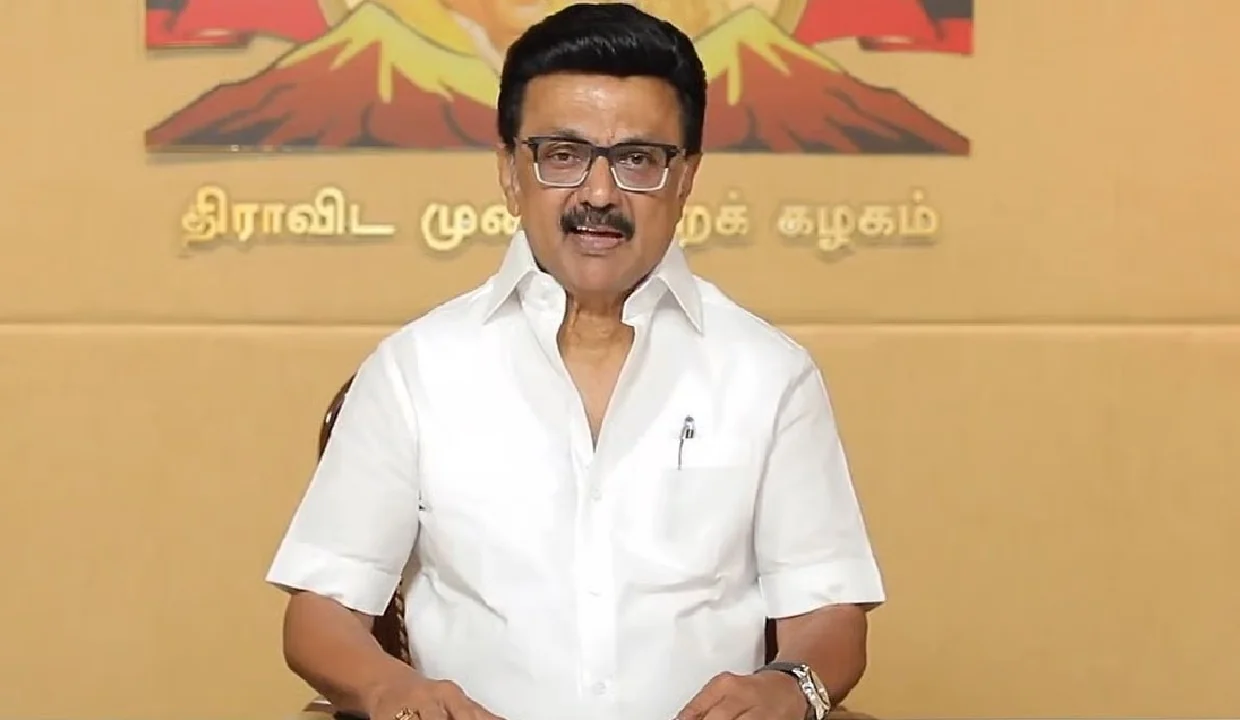
The South's Most Senior Statesman, and the 8,795 Votes That Ended His Term
On 7 May 2021 he was sworn in as Chief Minister of Tamil Nadu with a single-party majority. On 4 May 2026 he resigned. He had lost his own assembly seat in Kolathur to a 75-year-old TVK candidate most voters could not name a month earlier.
He was born on 1 March 1953 in Madras. He was the third son of M. Karunanidhi. The name his father chose for him announced what kind of politician he was being raised to be. Joseph Stalin, the Soviet leader, had died four days earlier.
Across the next seven decades, the boy named for him would hold almost every job the DMK had to offer. Campaigner at fourteen. General-committee member at twenty. Youth-wing founder at twenty-seven. MLA at thirty-six. Mayor of Chennai at forty-three. Deputy Chief Minister at fifty-six. Leader of the Opposition at sixty-three. Chief Minister at sixty-eight.
In May 2026, at seventy-two, he lost. He finished second in his own assembly seat in Kolathur, behind V. S. Babu of Tamilaga Vettri Kazhagam. Babu is 75. He is eighth-pass. His declared net worth is ₹3.67 crore. The margin was 8,795 votes. The DMK's vote share in the seat fell from 60.86% in 2021 to 40.32%.
Stalin was the first sitting Chief Minister of Tamil Nadu since J. Jayalalithaa in 1996 to lose his own constituency. He resigned on 4 May 2026.
This is a profile of how he got there. What the record looks like. What the voters who chose him for five years said when they were given the next ballot. And what the arguments are, on both sides, about how a forty-five-year career ended this way.
The apprenticeship
The most underrated fact about Stalin's career is not that he became Chief Minister. It is how long he waited.
He campaigned for his uncle Murasoli Maran in 1967, at age fourteen. He joined the DMK's general committee in 1973, at twenty. He was still a history student at Presidency College, Chennai. In 1980 he founded the DMK's youth wing. In 1982 he became its secretary. He held that post for thirty-five consecutive years — longer than the median lifespan of an Indian political party.
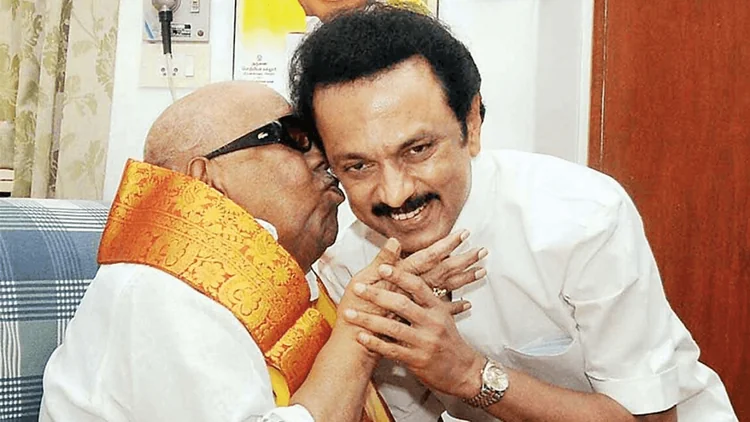
The youth wing was where Stalin learned a particular kind of work. Not speech-making. Not arithmetic. The grinding, unglamorous labour of organising eighteen-year-olds into booth committees, of remembering names, of showing up at the funeral of a worker's father in a district he could not find on a map.
By 2013, when Karunanidhi named him successor, Stalin's claim on the DMK was not just a claim of blood. It was a claim of infrastructure. He had built the party's lower half himself.
His critics inside the DMK saw it differently. Chief among them was his elder half-brother M. K. Alagiri, who was expelled in 2014 once the succession question came to a head. Alagiri's camp argued that the patient, institutional Stalin was also a cautious Stalin. Slower to confront. Less willing to take the risks his father had taken. The two readings of him — builder and incrementalist — would follow him into government.
Thousand Lights, Singara Chennai, and the long opposition stretch
In 1989 he won his first assembly seat. The seat was Thousand Lights, in central Chennai. He took 50.6% of the vote against the AIADMK's M. Thambidurai. He represented Thousand Lights across five elections. He lost it once, in 1991, and won it four times. From 1996 to 2002 he served as Mayor of Chennai.
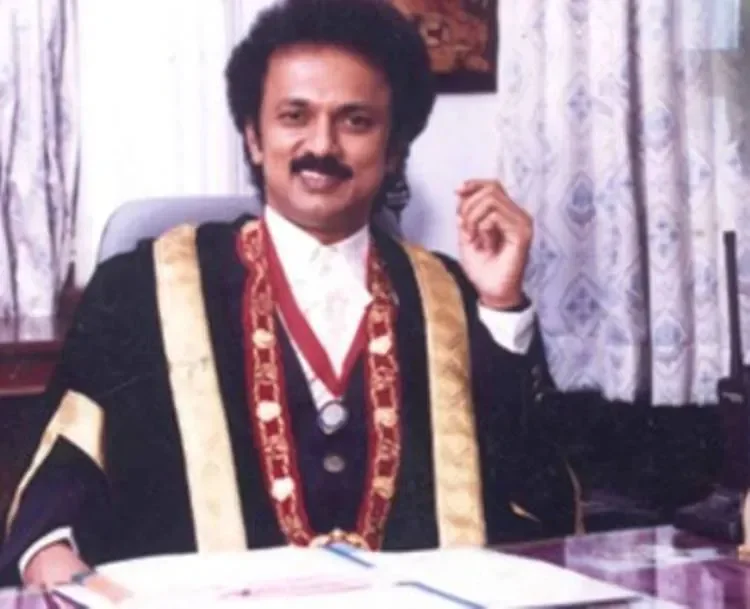
The mayoralty is the period of his pre-CM career on which admirers and critics most agree about the outputs. Nine flyovers. Forty-nine bridges. Eighty-one parks. The "Singara Chennai" beautification programme that still defines what the central city looks like.
They disagree on the meaning. Admirers read it as evidence Stalin was always an administrator first. Critics read it as evidence that Chennai-municipal scale was where his executive instincts worked best — and that scaling up to a state of seventy-six million was a different problem he never fully solved.
In 2002 Jayalalithaa's AIADMK government passed an amendment specifically banning a sitting MLA from also holding a mayoralty. Stalin resigned the mayor's office.
From 2006 to 2011 he served as Cabinet Minister for Rural Development. From 2009 to 2011 he was Deputy Chief Minister — the first formally designated holder of the title in Tamil Nadu.
Then the DMK lost the 2011 assembly election. Stalin entered the longest opposition stretch of his life. Ten years. Three Chief Ministers across the aisle: Jayalalithaa, then O. Panneerselvam, then Edappadi K. Palaniswami. He was sworn in as Leader of the Opposition on 24 May 2016. He held the role until 6 May 2021. Karunanidhi died in August 2018. Stalin became DMK president the same month.
When he finally took oath as Chief Minister on 7 May 2021, he was sixty-eight years old.
The 2021 mandate
The 2021 result was a clean win. The DMK-led Secular Progressive Alliance took 159 of 234 assembly seats. The DMK alone took 133. That was an outright single-party majority — the first the party had won under its own steam in twenty-five years.
In Kolathur, Stalin won 60.86% of the vote. He polled 1,05,522 ballots. His margin over the AIADMK's Aadi Rajaram was more than 49,000.
There is a version of the 2021 story in which the result was as much about the AIADMK's exhaustion after Jayalalithaa's death as about the DMK's positive case. Stalin's own circle has argued, then and since, that both readings are true. The AIADMK was exhausted. And the DMK had spent ten years rebuilding a positive case on which to govern. The voters who put Stalin in office were not asked which of the two motivations was theirs. They could not have been.
The Dravidian Model — the case the government made
What followed was a five-year experiment in branding governance as a coherent model rather than a sequence of schemes.
Stalin set up an Economic Advisory Council in June 2021. Its members included Raghuram Rajan, Esther Duflo, Jean Drèze, Arvind Subramanian and S. Narayan. It was the most academically credentialled brains trust any Indian state government had attempted. In August 2021 the DMK launched Tamil Nadu's first standalone agricultural budget. In a move framed explicitly around Periyar's legacy, the state began appointing temple priests from non-Brahmin castes.
Welfare delivery was the spine of the term. Free travel for women on ordinary intra-city buses began in his first week. Pudhumai Penn paid ₹1,000 a month to girls finishing government school, scaling toward college. Magalir Urimai Thittam extended a ₹1,000 monthly transfer to women aged 21+ in households earning under ₹2.5 lakh a year. A breakfast scheme was added on top of the existing midday-meal programme in government schools. Naan Mudhalvan and Illam Thedi Kalvi targeted skills and the COVID-era learning gap.
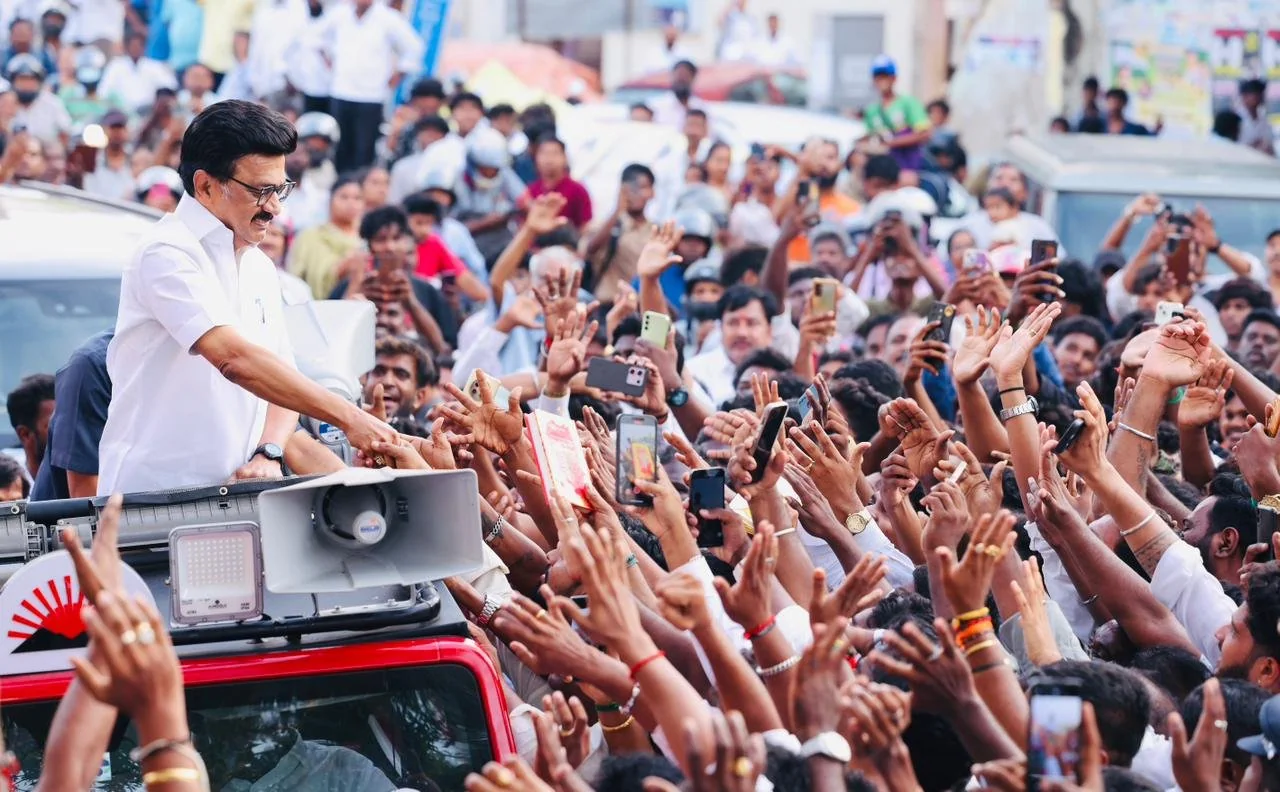
On macroeconomic prints, the government's case was strongest. Tamil Nadu's real gross state domestic product grew 11.19% in FY 2025-26. That was the state's first double-digit real-growth year in fourteen. Tata-JLR opened a ₹9,000-crore multi-energy vehicle plant in Ranipet in February 2026. VinFast inaugurated a $2-billion EV plant in Thoothukudi in August 2025. India Today's "Mood of the Nation" survey ranked Stalin India's best-performing Chief Minister in August 2021. The Indian Express placed him on its "most powerful Indians" list in 2022, and again in 2025.
What the voters then said
These are the metrics the government ran on. The voters had a different ledger.
Vote share is the cleanest summary of what the voters thought. The DMK polled 33.7% in its own column in 2021. By 2026, on early ECI returns, it polled in the mid-20s. That is not a swing inside the margin of error. That is a structural defection.
When asked, the voters who left did not tell a single story. The defection had at least four threads. The DMK's own post-mortem will eventually have to engage all four, not collapse them into one.
Welfare-as-handout fatigue. The most uncomfortable critique came from voters who received the transfers and still voted against the party that sent them. The argument was not that the schemes were bad. The argument was that the monthly cash transfer per household — bus pass plus Magalir Urimai plus Pudhumai Penn, where applicable — had become indistinguishable, in the household's accounting, from a wage. Once a transfer feels like a wage, the political response to it stops being gratitude. It starts being market-shopping. TVK's manifesto did not promise to repeal the schemes. It promised, on every stage, to increase them. The DMK never found a way to make "we created this" sound louder than the opposition's "we will pay you more."
Liquor revenue. Tamil Nadu's reliance on TASMAC for 14–18% of own-tax revenue ran across the entire term. It was one of the few governance critiques that united the DMK's right and left flanks. Periyarites argued the state had become structurally addicted to the same product the Self-Respect movement had once told women to fight. AIADMK and TVK candidates argued, on local stages across the term, that the welfare schemes were being funded out of poor households' bar bills.
The Sanatan moment. In September 2023, Deputy CM Udhayanidhi Stalin gave a speech. He compared Sanatana Dharma to malaria and dengue. He called for its eradication. Inside Tamil Nadu's Periyarite tradition the sentence had a long lineage. Outside Tamil Nadu, on national television, it became the centrepiece of an argument that the DMK was hostile to Hindu identity. The BJP did not win the state in 2026. It did not need to. What it did was move a layer of culturally observant, middle-caste Hindu voters in semi-urban Tamil Nadu off their reflex DMK vote. TVK collected most of them.
The succession. In September 2024, Stalin elevated his son Udhayanidhi to Deputy Chief Minister. The elevation was clean by internal-DMK standards. No Alagiri-style breakaway. No public revolt. But to a voter who had not lived through the 2014 Alagiri expulsion or the 2017 working-presidency handover, the optic was simpler. A 71-year-old CM had made his 46-year-old son the number two of the government. TVK's pitch was built directly against that frame: new party, no family, no inheritance. Joseph Vijay's choice to stand alone on the ballot, with no alliance partner and no second-generation heir, was the closing argument.
The Delhi fight, and what it cost
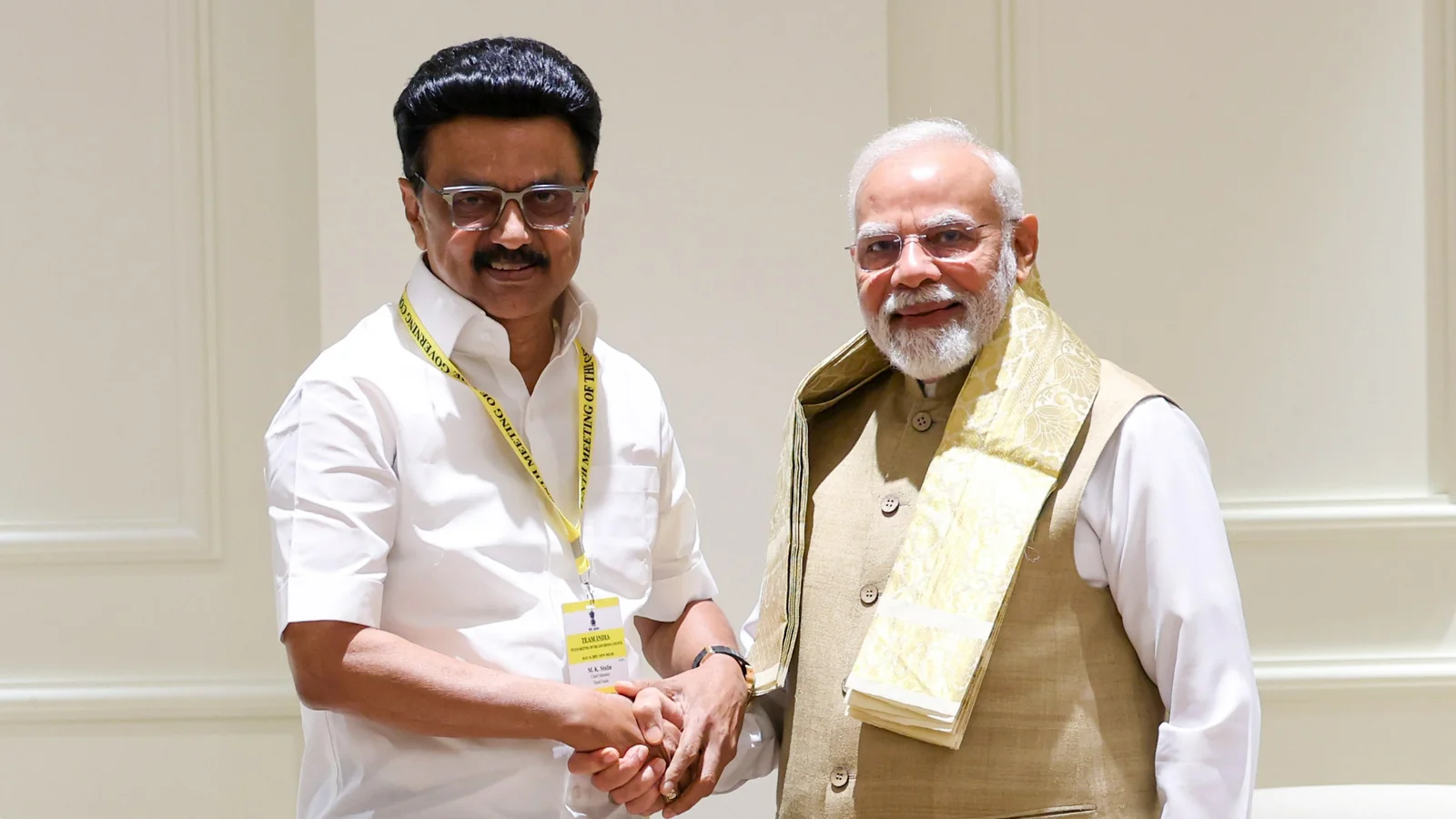
Stalin spent the back half of his term in a running constitutional argument with the Union government. The fights kept arriving. NEET, the medical-admissions test. The push to install Hindi in central institutions. Governor R. N. Ravi's withholding of bills passed by the state assembly. And finally delimitation.
The delimitation fight is the one history will likely remember. In April 2026, three weeks before counting day, the Union government brought a constitutional amendment. The amendment would implement delimitation and women's reservation using the 2011 census, rather than waiting for the 2027 enumeration. Stalin published the arithmetic. Tamil Nadu stood to lose eight Lok Sabha seats. Uttar Pradesh stood to gain eleven. He led black-flag protests in Chennai. He built a cross-state southern coalition with the CMs of Kerala, Karnataka and Telangana. The bill was defeated in the Lok Sabha on 17 April 2026.
This was a substantive constitutional victory. It is also true, separately, that Stalin spent the final fortnight of the campaign on it.
His supporters argue the two are connected only by coincidence. The delimitation fight had to be fought when it was scheduled. Backing down would have ceded the southern position for a generation. Vijay's surge was already locked in by mid-April.
His critics argue the opposite. Cadre attention is finite. The federal-constitutional vocabulary Stalin fought in was not the vocabulary 2026 voters under thirty were thinking in. And the BJP, which had no path to winning Tamil Nadu, was content to extract Stalin's final-fortnight bandwidth in exchange for losing a Lok Sabha vote it could re-table later.
Both readings can be true. Voters do not have to choose between them. A profile should not pretend they do.
Kolathur
The cleanest test of any sitting CM is the seat with their own name on it. Kolathur was the test. The test result is in the public record.
V. S. Babu of TVK won the seat with 82,997 votes. Stalin finished second with 74,202. The margin was 8,795 votes, or 5.59% of the top-two vote share. P. Santhana Krishnan of the AIADMK finished a distant third with 18,430. NTK's Soundara Pandian Luder Seth managed 5,046. Thirty-six candidates contested in total.
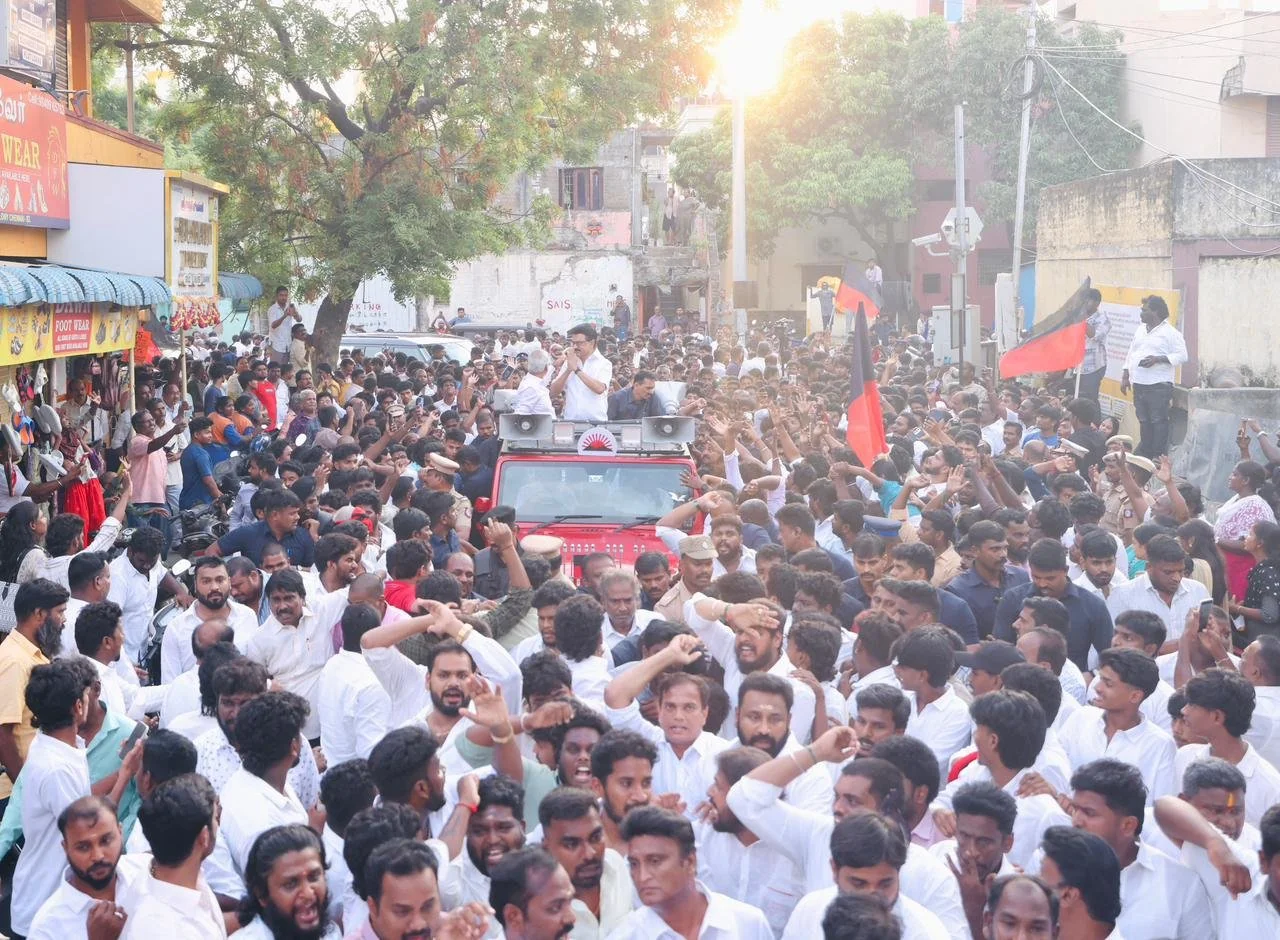
The pattern was not specific to Kolathur. Across Chennai's fourteen seats, the DMK lost ten. Among them was Chepauk-Triplicane, where Udhayanidhi himself was the candidate. In western Tamil Nadu — Coimbatore, Tiruppur, Erode — the DMK was reduced to a handful of seats. In the southern districts where it had historically competed with the AIADMK, it now finished third in dozens of seats behind TVK.
The DMK's strategists had run their year on a piece of arithmetic. A three- or four-cornered fight between DMK, AIADMK, TVK and the BJP-aligned bloc would split the anti-incumbency vote. The DMK would come up the middle on 28–30%. That arithmetic broke on a single fact. TVK did not split the anti-DMK vote. It consolidated it. The AIADMK finished worse than it had hoped. The BJP-aligned bloc finished worse than it had hoped. TVK absorbed almost the entire anybody-but-Marina vote across every age cohort under forty.
What the record actually was
Any honest profile of Stalin has to hold two things at once.
The first is that the 2026 verdict was a vote of removal. Voters who had given him a single-party majority five years earlier withdrew it decisively. The DMK is in the 2026–31 assembly with roughly 71 seats — its smallest count since 1991. The Leader of the Opposition's chair, which Stalin held from 2016 to 2021, is the one he returns to at seventy-two.
The second is that the record he leaves is not the record of a government that did nothing. Free buses for women. Breakfast in government schools. Pudhumai Penn and Magalir Urimai. The agricultural budget. The temple-priest reform. The Tata-JLR plant in Ranipet. The VinFast plant in Thoothukudi. The laptop-distribution restart. The 11.19% real-growth print. The successful delimitation defence. These are line items the next government will inherit and, in most cases, continue. TVK has explicitly committed not to repeal the women's-bus scheme or the breakfast programme.
Supporters and critics disagree most sharply on what those two facts mean together. To supporters, the 2026 verdict is an electorate that took good governance for granted and chased novelty. To critics, the verdict is an electorate that received the transfers, watched the Udhayanidhi elevation, sat through the Sanatan flank-fight, and decided across class, caste and region that a clean break was preferable to a fifth Karunanidhi-line term. The voters did not write op-eds explaining themselves. The number 8,795 is what they wrote.
What he leaves behind
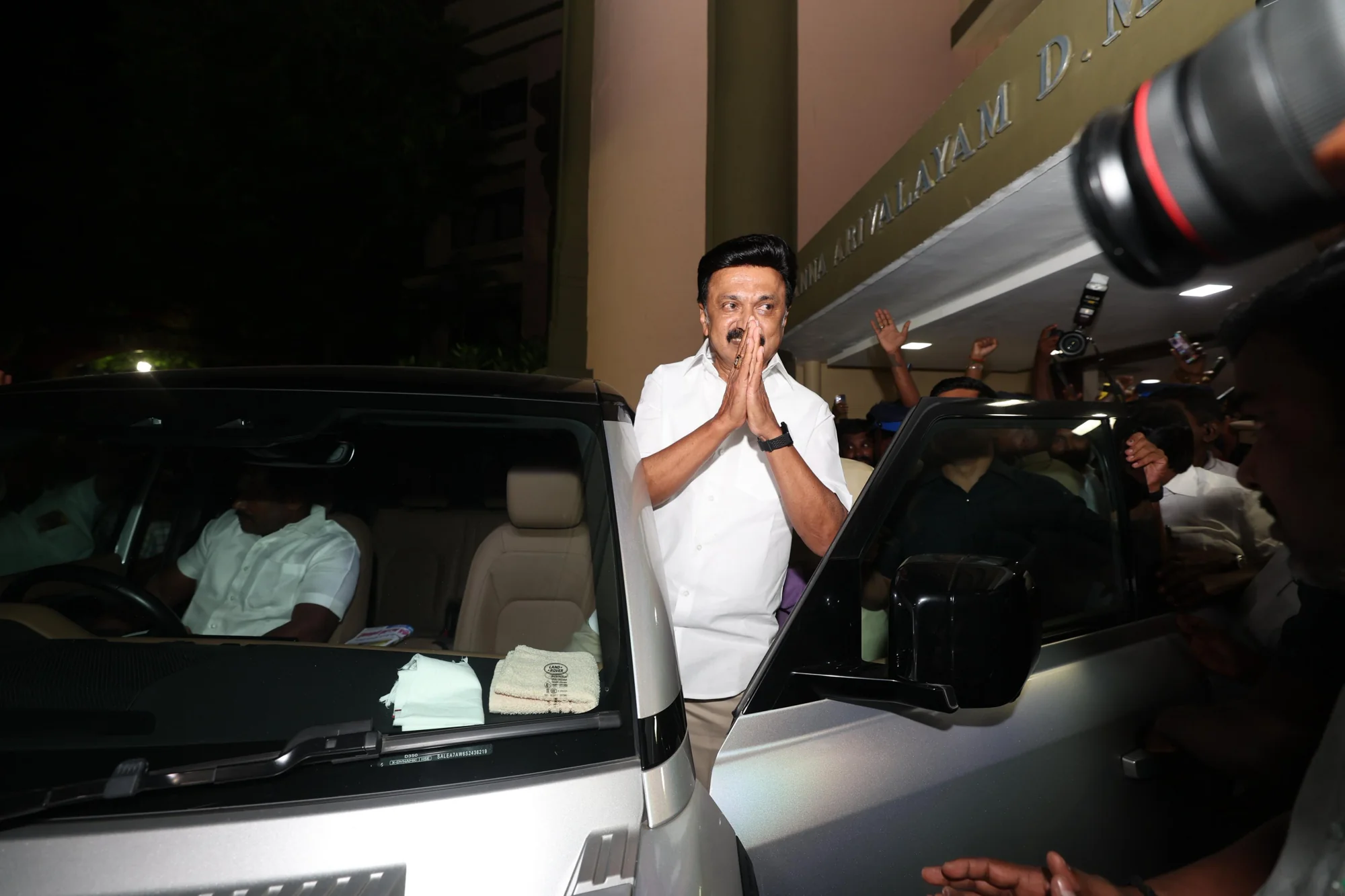
On 4 May 2026 Stalin walked into Raj Bhavan and submitted his resignation. It was two days after counting and one day before Joseph Vijay's swearing-in. He left the gate of Anna Arivalayam, the DMK headquarters at Teynampet, late that night. Folded hands. No statement.
He remains, at the time of writing, president of the Dravida Munnetra Kazhagam. The DMK's 71 seats make it the largest single opposition bloc by some distance. Stalin will be Leader of the Opposition for the second time in his life. He will be 77 by the next assembly election in 2031. Whether he contests again is a question his own party has not yet asked in public, and may not need to ask for another two years.
The career is forty-five years of organising work. Then five years of executive work. Then one count. Each of those three numbers is part of the record.
Tamil Nadu's voters in 2026 weighed all three. They produced a verdict. The verdict is the data point.
The arguments about what it means belong elsewhere. Were the schemes too generous, or not generous enough? Was the Sanatan speech a strategic blunder, or a doctrinal continuity? Was the Udhayanidhi elevation a succession, or an inheritance? Was the delimitation fight the right hill to die on? Was five years enough for any government to make the case TVK undid in eighteen months?
Those arguments belong to the cadre. To the opposition that defeated him. To the next generation of voters, who will be asked, on their own ballot, what they think of all of it.
Stalin's career, on the data, is among the most fully documented political lives in modern India. What it means is for readers to weigh. The figures here are the figures.