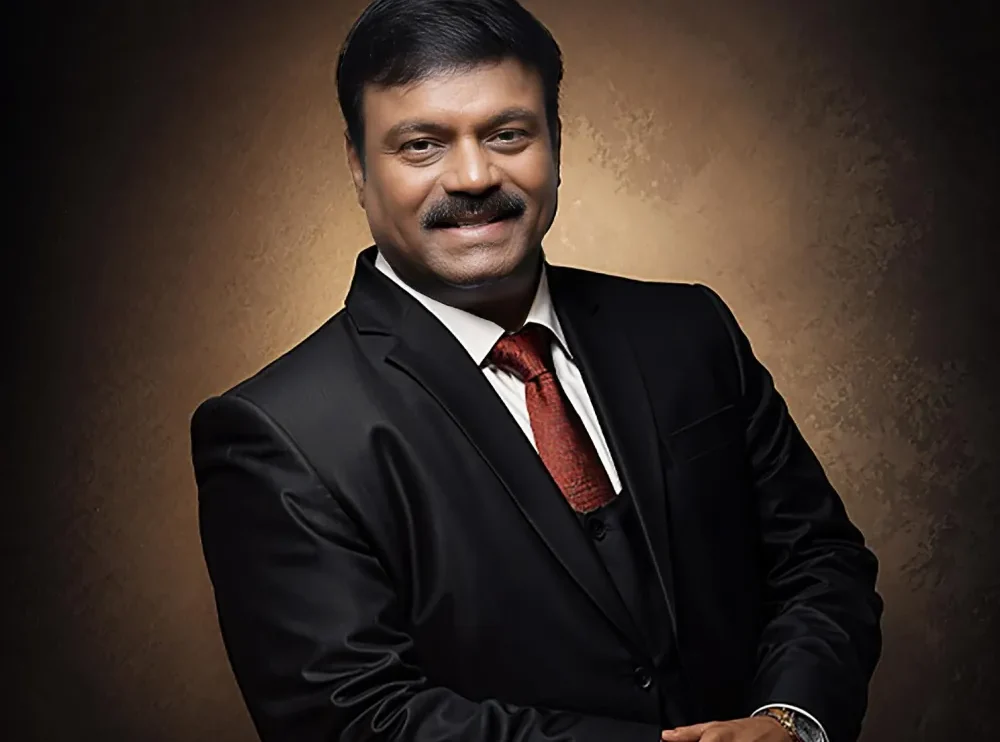
The Builder Who Got AI
R. Kumar built a ₹117-crore fortune in concrete and granite — the most physical industry there is. Then Joseph Vijay handed him the most abstract portfolio in the cabinet: Tamil Nadu's first dedicated ministry for Artificial Intelligence.
Tamil Nadu had never had a Minister for Artificial Intelligence. On 21 May 2026, it got one — and the man Chief Minister C. Joseph Vijay chose to run the most futuristic department in the cabinet had spent the previous thirty-five years pouring concrete.
R. Kumar is the MLA for Velachery, the south Chennai neighbourhood that functions as the city's gateway to its IT corridor. He is also, by a wide margin, the wealthiest member of the new government — ₹117 crore in declared assets — and now holds a portfolio that did not exist in Tamil Nadu until he was sworn into it: Minister for Artificial Intelligence, Information Technology and Digital Services.
It is one of the more improbable pairings in the cabinet. A self-made magnate in prefabricated concrete and granite, handed the abstract frontier of machine intelligence. This is the story of how a builder got AI.
A first for Tamil Nadu
The ministry itself is the headline. Until this cabinet, no Tamil Nadu government had carved out a portfolio dedicated to artificial intelligence. TVK put it in writing during the campaign — an AI agenda was part of the party's 2026 manifesto — and on swearing-in day, the promise became a department with a minister's name attached.
Tamil Nadu is not the first Indian state to do this. Kerala got there earlier, creating an AI ministry under its Congress-led government. But Tamil Nadu's version is its own dedicated structure, and the ambition behind it is specific. The stated plan is to seed AI innovation hubs in Madurai, Coimbatore, Salem and Tiruchirappalli — pointedly outside Chennai — and to support 1,000 deep-tech startups through them.
Until this cabinet, no Tamil Nadu government had a Minister for Artificial Intelligence. R. Kumar is the first.
Whether that agenda survives contact with a state budget is a question for later years. What matters for now is the signalling: a new party, governing for the first time, chose to announce itself partly through a portfolio that reads as a statement about the future. And it gave that statement to a sixty-year-old contractor.
The richest man in the cabinet
Before the politics, the numbers — because they are extraordinary.
Kumar's election affidavit declares assets of ₹117.83 crore against liabilities of about ₹1.6 crore. In a cabinet whose wealth we have mapped seat by seat, no one else is close. It is not inherited money, and the affidavit makes that legible in a way that is almost a portrait in itself:
- A ₹60-crore residential property in Adyar — a single house carrying more value than most ministers' entire declared worth.
- Non-agricultural land and commercial units across Kodambakkam, Mylapore, Anna Salai and the city's northern fringe, together worth tens of crores.
- A garage that reads like a brochure: a Mercedes-Benz, a BMW, a Toyota Innova.
- Over 2.2 kilograms of gold, and a watch declared at ₹20 lakh.
- A capital balance of over ₹5 crore in his sole proprietorship, plus equity and mutual-fund holdings.
And, importantly for the record: zero criminal cases. A ₹117-crore businessman entering politics with a clean affidavit is not the stereotype, and it is worth stating plainly.
There is a temptation to gawk at a list like this. The more interesting fact is where it came from.
From contract labour to CREATIONS
By his own account, Kumar is a first-generation entrepreneur who financed his own engineering education through contract work — a Don Bosco student who paid his way to a degree.
He took his Bachelor of Engineering in Civil from the University of Madras in 1989, and that same year founded CREATIONS, a construction firm. A year later, in 1990, he moved into prefabricated concrete products — pioneering, the company claims, prefab concrete in Tamil Nadu at a time when the technology was barely used in the state. From there the business widened: Vinay and Jubilee Granites in stone exports (a thirty-metre monumental stone fountain shipped to Abu Dhabi is the line his own materials like to cite), and Creations Promoters and Developers in residential real estate.
Much later, in 2024, he added a Business Leadership Programme from IIM Bangalore to the CV, and somewhere along the way an honorary doctorate (2017) that explains the "Dr." his campaign material uses.
He also built a philanthropic operation around the business. The Creations Charitable Trust, founded in 2017, runs healthcare, education and elderly-care work; among its more unusual projects is a mental-health programme for over 750 Tamil Nadu Fire and Rescue officers — first responders, the people who walk toward disasters. As Kumar's own framing puts it: "The greatest legacy is not wealth, but the lives we transform."
It is, in other words, a classic Chennai builder's arc — concrete, granite, real estate, a trust — scaled to nine figures.
Why Velachery fits
The seat is not an accident of the story. It is part of it.
Velachery sits at the hinge of Chennai's old residential south and its new technology economy — the on-ramp to the Old Mahabalipuram Road IT corridor and Taramani, where much of the city's software industry actually works. A constituency that lives next to the IT corridor, represented by the minister now responsible for IT and AI, is a tidier fit than most cabinet assignments manage.
Kumar won it decisively. He polled 80,430 votes — about 43.5% — and beat the AIADMK's M.K. Ashok by a margin of 33,305. For a first-time candidate in a Chennai seat with no shortage of established machinery, that is a clean win, not a narrow one. The booth-by-booth result is here.
The bet
So what is the wager Vijay made here?
The optimistic reading writes itself: a man who built businesses from nothing, scaled them across decades, ran a charitable trust at size, and topped it with an IIM management programme is exactly the kind of operator you want translating a manifesto line into actual innovation hubs and startup support. Execution, not slogans. The portfolio needs someone who can build, and Kumar has spent his life building.
The skeptical reading also writes itself: prefab concrete and machine learning are not adjacent fields, and a sixty-year-old civil engineer is an unobvious choice to steer a state's artificial-intelligence policy against the likes of Karnataka and Telangana. The hubs in Madurai, Coimbatore, Salem and Tiruchirappalli are a promise on paper; deep-tech ecosystems are not poured like foundations.
Both readings are fair, and only the next few years will settle which one was right. What is already settled is the symbolism. Tamil Nadu's first AI minister is its richest, a builder by trade, in a seat that touches the IT corridor — a new government announcing the future, and choosing a man who made his fortune in the most physical industry there is to deliver it.
For R. Kumar, the distance from a concrete yard to an AI ministry turned out to be one election long.